
Beyond the Cover and Awards
Is it just another hero image?
A friend who had seen The Silos Accommodation on the cover of Sanctuary magazine, asked me, “Do you have that kind of thing in your mind when you start a design, coming up with something worthy of a magazine cover?” In the same week, just before it won a major prize at the Sustainability Awards, a highly regarded sustainability builder said to me “I think these prizes just go to the projects with the best hero image anyway, don’t they?”
And I get it. I’ve been known to criticise media, awards programs and designer motivations with very similar sentiments in the past. But now the tables are turned and I feel compelled to write an article explaining that we most definitely do NOT think about the magazine cover hero image as a design motivator, and that we would desperately love to share all the juicy detail and data behind the ‘hero image’ that makes this project worthy of the awards it is recieving and the word of mouth that follows it around.
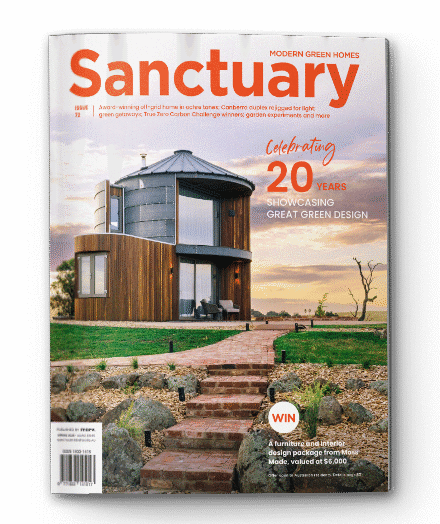
A Farmstay with Purpose.
At its heart, The Silos Accommodation is the realisation of a fifth-generation farming family’s idea: to convert a disused 60-year-old grain silo into a sustainable farmstay, diversifying their income while sharing their landscape, values, and regional culture with the public.
Their vision is much deeper than novelty. It was about:
Demonstrating sustainable rural living
Reusing a unique rural structure and site rather than building new
Creating a legacy for their children, and
Providing a place where visitors can learn about, connect with, and experience rural sustainability and culture in action, while completely switching off.
Australia’s regional–metropolitan divide is alive and well, and this project intentionally responds to that tension by creating a comfortable, experiential form of education and cultural exchange. It helps strengthen our collective identity and proudly adds to the history pages of the stories we tell ourselves about who we are.
User experience is the true driver of this project. Everything from arrival sequence, views from different spaces, to surfaces you touch, choreographs a stay full of rich discovery and delight.
Adaptive Reuse Maximised.
Every single element of the original two silos was retained and reused.
The original steel silo serves as the cladding for the new building (silos are very thin modular skins with no separate structure, so this needed to be added to make the building livable). Extra rings were added from the second silo to achieve the necessary height for the loft. (The remains of the second silo are stored away for future opportunities).
The grain chute and ladder are reinstalled as functional landscape/interaction elements.
The silo doors mark the property's entry.
The highly degraded concrete slab was broken up and reused as paving for the outdoor hot tub area.
Recycled brick paving (local), recycled timber, and some recycled light fittings were also incorporated into the works; however, we acknowledge that many new materials and fittings were still used.
The silo sits on the exact same site.
We must get better at valuing the existing buildings we have and respecting the materials and labour that went into them, rather than approaching buildings with a fast-fashion throwaway attitude. Of course, there’s always a challenging context to adaptive reuse and renovation projects, but we’re proud that this project shows what's to be gained from taking on that challenge.
Solar-Passive Thinking from First Principles
The project’s distinctive geometry isn’t just beautiful, it’s strategic.
Orientation, glazing placement and sizing, wind protection, guest arrival experience, and views were all considered with solar-passive design at the centre.
Early-stage NatHERS (star rating) modelling was used early in the concept to optimise solar-passive design (window sizes, direction, shading), particularly the exact orientation the building should be rotated to.
Night-purge cross-ventilation was designed into the floor plan.
The insulated concrete slab base acts as a temperature stabiliser, storing warmth from the sun in winter and extracting heat from the room during summer (see how this works here.)
This means that despite the challenges of retrofitting a curved steel structure, the project achieves:
NatHERS 7-Star Rating. While we aim higher on our other projects, 7 is a good result in the context of the micro-footprint, loft structure and pre-existing building constraints.
BASIX Energy Score of 99 (considers both building thermal efficiency, and appliance requirements/power generation)
At only 41 m², its compactness is integral to its sustainability story. It demonstrates that comfort and luxury do not require scale — and in fact, that smaller spaces can amplify delight. We love hearing and reading comments from visitors that they ‘could easily live there’… even the clients were nervous about how functional the tiny footprint that we proposed would be!
A Carefully Considered Building Envelope
The curved silo walls required some critical thinking, particularly when it came to minimising steel in the wall structures (steel is highly conductive, and challenging to insulate in walls). We worked with the builders and engineers to resolve this in a way that was still relatively cost-effective and practical, and kept the wall structure thin enough to not eat into the critical internal dimensions. Overall, we achieved:
R5 roof insulation
R2.5 wall batts, thermal break tape to minimised necessary steel columns, and timber stud wall framing generally (a rarity in circular geometries)
R1.8 XPS slab insulation under the burnished concrete floor
Double-glazed uPVC windows with low-e coating
The airtightness has not yet been tested due to rural service availability, but detailing aligns with our other projects that consistently achieve 4–6 ACH at 50Pa, supporting HRV installation as part of the strategy. We find this level of air-tightness to be a sweet spot when it comes to ‘bang-for-buck’; it’s achieved using only attention to detail at the plasterboard level and good quality windows/exhaust fans/fittings, but delivers significantly reduced energy consumption compared to a default build. (We share a lot of detail on how to achieve this in our Cooee Retrofit Method.)
Future Resilience
The intensity and frequency of storms and emergency events are set to increase considerably in the coming decades.
The project is detailed to a voluntary BAL 12.5 (basic emberproofing) even though no rating was required.
The form shields prevailing winds while opening to prized views, ensuring guests can have a great experience even if the wind picks up.
Increased wind storm intensity was workshopped with the engineers to ensure that this tall structure on an exposed site would stand robustly.
An All-Electric, Off-Grid Experience
The farmstay operates completely off-grid, proving that regional luxury accommodation can be both indulgent and energy independent. This even includes induction cooking, heat-pump hot water and electric vehicle charging. It was important to us to dispel many myths that these systems don’t work unless you have a grid connection. I would like to comment that grid connection is always a sustainability preference, if it’s available, due to the ability to extend your power generation to others and operate on the whole with less solar infrastructure, but in many rural conditions (like this project) grid connection isn’t viable.
Energy System
10.8 kW PV array
12 kW inverter
25.6 kWh battery
10 kVA diesel backup generator only for emergency conditions
Heating, Cooling & Hot Water
High-efficiency heat pump hot water
Reverse-cycle air-conditioning (for heating and cooling)
Ceiling fan
High-efficiency wood fire with external air intake (while burning things to create heat is contentious amongst sustainability circles, we feel that in a remote rural context, it is appropriate and also offers mindfulness and cultural benefits.)
LUNOS NEXXT heat-recovery ventilation for superior indoor air quality without temperature loss
The result is a building that teaches guests — often without them realising — what quiet, comfortable, healthy, low-carbon living feels like.
Water and Waste Systems
2000L tank capturing carport roof water for edible garden beds
Silo roof water directed into a gravel “creek” landscape swale
5–6 Star WELS tapware, 4-Star WELS toilet (though we fully see the irony in highlighting these fittings right next to experienced that focus on bathing in large tubs!)
Aerobic worm-farm septic system (significantly lower off-gassing than legacy septic designs), which can also take compostable and green waste. This means all the packaging that guests is composted on site or recyclable.
Regenerative Landscape
What was once a silo site with sheep camping around the base, now supports and encourages increased biodiversity.
Hundreds of trees were planted along the long laneway approach
Improved groundcover and some habitat restoration (though planting is strategic for limiting bushfire risk to guests)
Appreciation encouraged for existing wildlife, including a nearby old dead teeming with birdlife, and the resident kangaroos that roam the working farm
‘Dark-sky lighting’ was considered (preference for warmer temperature outdoor lighting, downward facing lighting and lighting on sensors) but as this was our first project where we were aware of this, we look forward to getting better at this.
We also want to note that all of this is achieved with the working farm continuing to brush right up against the silo site. Environmental preservation and regeneration are important, and protecting our ‘food bowls’ is essential; these two priorities can coexist.
Health, Wellbeing & Indoor Quality
Guest comfort and health were a non-negotiable part of the brief.
No gas appliances
Low-VOC finishes throughout
High levels of draft-proofing
Heat-recovery ventilation and humidity-sensing bathroom fan
External-air-intake for wood heater
Visual connection to landscape and raw/natural materials tending towards earthy or ‘biophilic’ choices
A Subtle but Powerful Educational Experience
Every choice — from the battery system to the small footprint — is part of the owners’ aim to use the property as a quietly educational experience for guests.
Visitors learn without being lectured. They absorb:
The feel of naturally comfortable spaces
The logic of passive design
The joys of low-energy, all-electric living
The richness of rural culture and regenerative farming practices
This intent is confirmed by consistent 5-star guest reviews that call out the thoughtful detailing, comfort, and uniqueness of the stay.
Could We Do More?
Always. For example, we had to abandon the slab-edge insulation due to challenges detailing it in a curved fashion. But, at the same time, we simulated the reality of the impact of losing it (it was very tiny in the context of this project) to help us weigh up the cost of pursuing a solution. I get pretty sick of our industry self-promoting perfection outcomes, because the reality is that perfection comes at a high cost. I’m passionate about optimising within the project context and I believe this is where Cooee’s experience and skillset really shines.
More Than a Hero Image
While the photographs of The Silos are visually stunning, capturing people’s attention and imagination, the real story for us is in the design, detailing, research, systems, performance, and critical thinking. As the legendary Australian architect Glenn Murcutt often says, “to be simple is not to be simplistic”, meaning that the intelligence and thinking required to pull off a design that is stunningly coherent and refined across all scales and purposes is no easy feat. I like to think that The Silos Accommodation is being celebrated across many platforms because we’ve managed to achieve something along these lines.
See More
Project team and credits: see the team
Additional story/details: view the details
To book a stay at The Silos: www.thesilosaccommodation.com.au
Looking for more?
To see more details on The Silos Accommodation, click here.