Image 1 of 2
 Image 2 of 2
As seen in Sanctuary Magazine:
“The distilled information, clearly laid out guidelines and helpful checklists are likely to save the average renovator so much research time that I’d say it’s very good value.”
— Anna Cumming, Sanctuary Magazine
Independent Reviews
“Practical, actionable advice that delivers great bang for buck.”
— Jenny Edwards ‘Fixit Chick’, Light House ArchiScience
“Sarah Lebner has packaged up a wealth of experience and industry knowledge to radically simplify retrofitting your home.”
— Amelia Lee, Undercover Arcitect
“Sarah has created a clear and practical resource that anyone can use.”
— Jeremy Spencer, Co-Founder Sustainable Builder’s Alliance
“This is an outstanding resource - clear, practical and grounded in real-world retrofit experience. Sarah has distilled complex ideas into something genuinely useful.”
— Andy Pickard, Powerhaus Engineering
The Problem Many Homes Have
Does winter in your house feel like a battle and summer like a marathon?
Many Australian homes were built before energy performance was well understood.
As a result, they can be:
• cold in winter
• hot in summer
• expensive to heat and cool
• prone to condensation and poor indoor air quality
Homeowners often respond by upgrading finishes or installing bigger heating and cooling systems — but these rarely solve the underlying problem.
The Key Idea
Most renovation advice focuses on what to buy.
The Retrofit Method focuses on what to do first.
Because the order of decisions matters.
Too often homeowners spend large sums on kitchens, bathrooms or windows without addressing the things that actually determine comfort and health — insulation, air leakage, solar gain and ventilation.
The Cooee Retrofit Method explains how to sequence upgrades logically, so each step builds on the previous one and delivers the biggest improvement for your budget.
What You'll Learn
The guide walks you through the essential stages of improving an existing home, including:
• Draughtproofing and air leakage
• Ventilation and indoor air quality
• Solar control and shading
• Insulation upgrades
• Windows and glazing
• Appliances, electrification and heating/cooling
Each section focuses on the highest-impact improvements first, helping you achieve the greatest comfort and efficiency gains for the least cost.
Real Homes, Real Examples
The guide is supported by two detailed video walkthroughs of real homes, where Sarah explains how she would approach retrofit decisions in practice.
These include:
• A 1990s Canberra brick veneer home, where targeted upgrades lifted the NatHERS rating from 2.9 to 5.8 stars for just $9,000 (a 60% reduction in heating and cooling load).
• A 1950s concrete block cottage on a farm in the Snowy Mountains, exploring strategies for both a low-budget retrofit and a larger renovation scenario
Seeing the process applied to real houses helps translate the principles into practical decisions you can make in your own home.
Who This Is For
This guide is designed for:
• Homeowners planning a renovation or retrofit
• People wanting to improve comfort and reduce energy bills
• Anyone overwhelmed by conflicting renovation advice
• Those wanting to make smart decisions before spending serious money
It includes strategies for people on budgets from just $500 through to $250,000
Why This Guide Is Different
The Retrofit Method is intentionally concise and distilled — focusing on the retrofit decisions that matter most.
It’s a unique summary of 15 years of experience designing climate-responsive homes, including time working alongside building scientists and builders at Light House Architecture & Science and Jigsaw Housing.
During this time we simulated designs, tested buildings as-built and tracked real lived-in performance data.
Rather than overwhelming readers with hundreds of pages of technical detail, it focuses on the key decisions that matter most. We understand that everyone is busy, and suffering from information overload, so we worked incredibly hard to keep this framework digestible and actionable.
As reviewed in Sanctuary Magazine
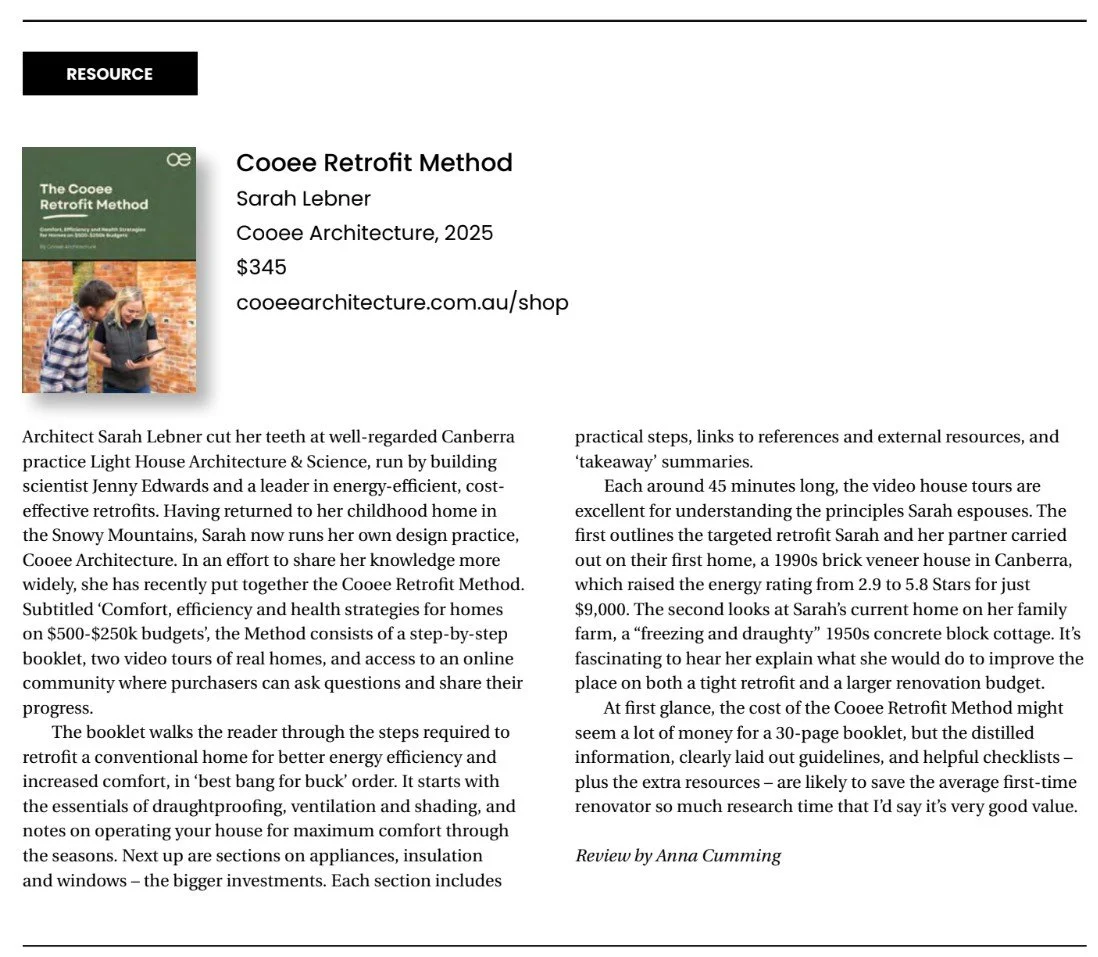
“At first glance, the cost of the Cooee Retrofit Method might seem a lot for a 30-page booklet, but the distilled information, clearly laid out guidelines, and helpful checklists — plus the extra resources — are likely to save the average first-time renovator so much research time that I'd say it's very good value.”
— Anna Cumming, Sanctuary Magazine
(See further industry leading reviews below!)
About Sarah
Sarah Lebner is the founder and director of Cooee Architecture, a regional practice based in the Snowy Mountains. Her work focuses on climate-responsive, comfortable homes that perform well on realistic budgets.
She previously worked at the respected Canberra practice Light House Architecture & Science, collaborating closely with building scientists and builders on high-performance retrofit and new-build projects.
Sarah was awarded the 2020 National Emerging Architect Prize by the Australian Institute of Architects for her work in affordable energy-efficient housing and housing education.
Good retrofits aren't about spending more money.
They're about making better decisions in the right order.
The Cooee Retrofit Method shows you how.
Inside the Guide
The handbook covers topics including:
• Draughtproofing and condensation management
• Ventilation and indoor air quality
• Appliance and electrification audits
• Insulation upgrades (ceiling, walls and floors)
• Window retrofit options
• Trade tips and common retrofit pitfalls
• References and further resources
A full page-by-page contents list is shown below for those who want to explore further.
Contents:
Page 1: Bottom-half homes
Page 2: What’s a ‘conventional’ home?
Page 3: In likely order of bang-for-buck
Page 4: Who am I?
Page 5: Steps (contents)
Page 6: Draftproofing - why?
Page 7: Managing condensation
Page 8: Get off gas
Page 9: Draftproofing - what to do
Page 10: Draftproofing - how to do it
Page 11: Ventilation - what to do
Page 12: Home operation
Page 13: Where to draw the line (on budget)?
Page 14: Appliance audit (heating and cooling, hot water)
Page 15: Appliance audit (alternative heating and cooling)
Page 16: Appliance audit (other appliances)
Page 17: Electrical audit
Page 18: Insulation: ceiling
Page 19: Insulation: wall
Page 20: Insulation: floor
Page 21: Window upgrades
Page 22: Windows: retrofit
Page 23: Trade tips
Page 24: Some final bits (VOC & light temperature)
Page 25: Two home tours (links)
Page 26: Join our group
Page 27: Reviews
Page 28: References
Page 29: References